// FAQ
SITE CUT QUESTIONS
Straight answers on cuts, ground conditions, spoil and machine access across the Yarra Valley and Melbourne's outer east.
What is the difference between a site cut and bulk excavation?
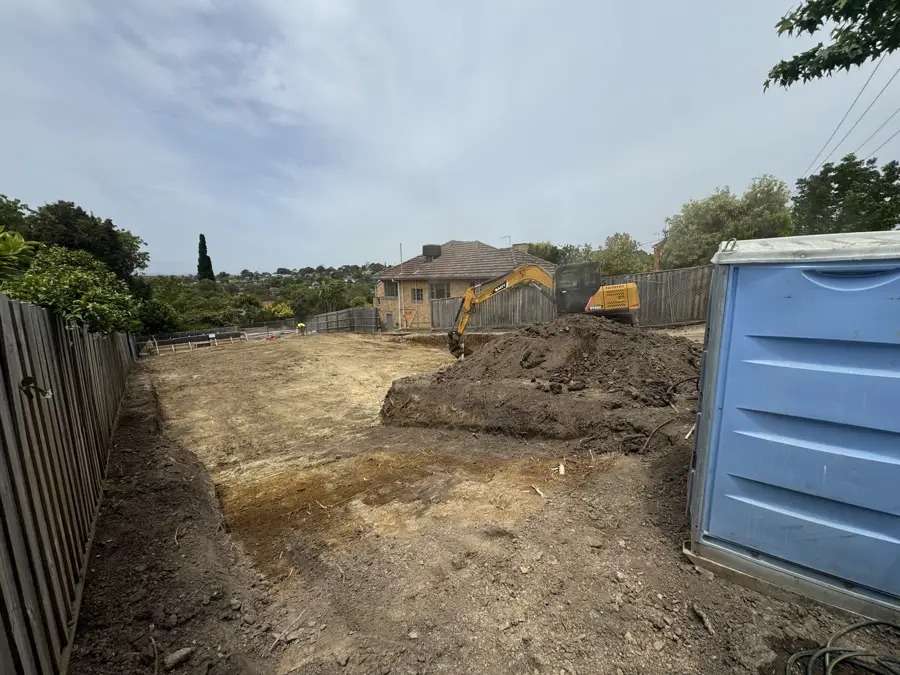
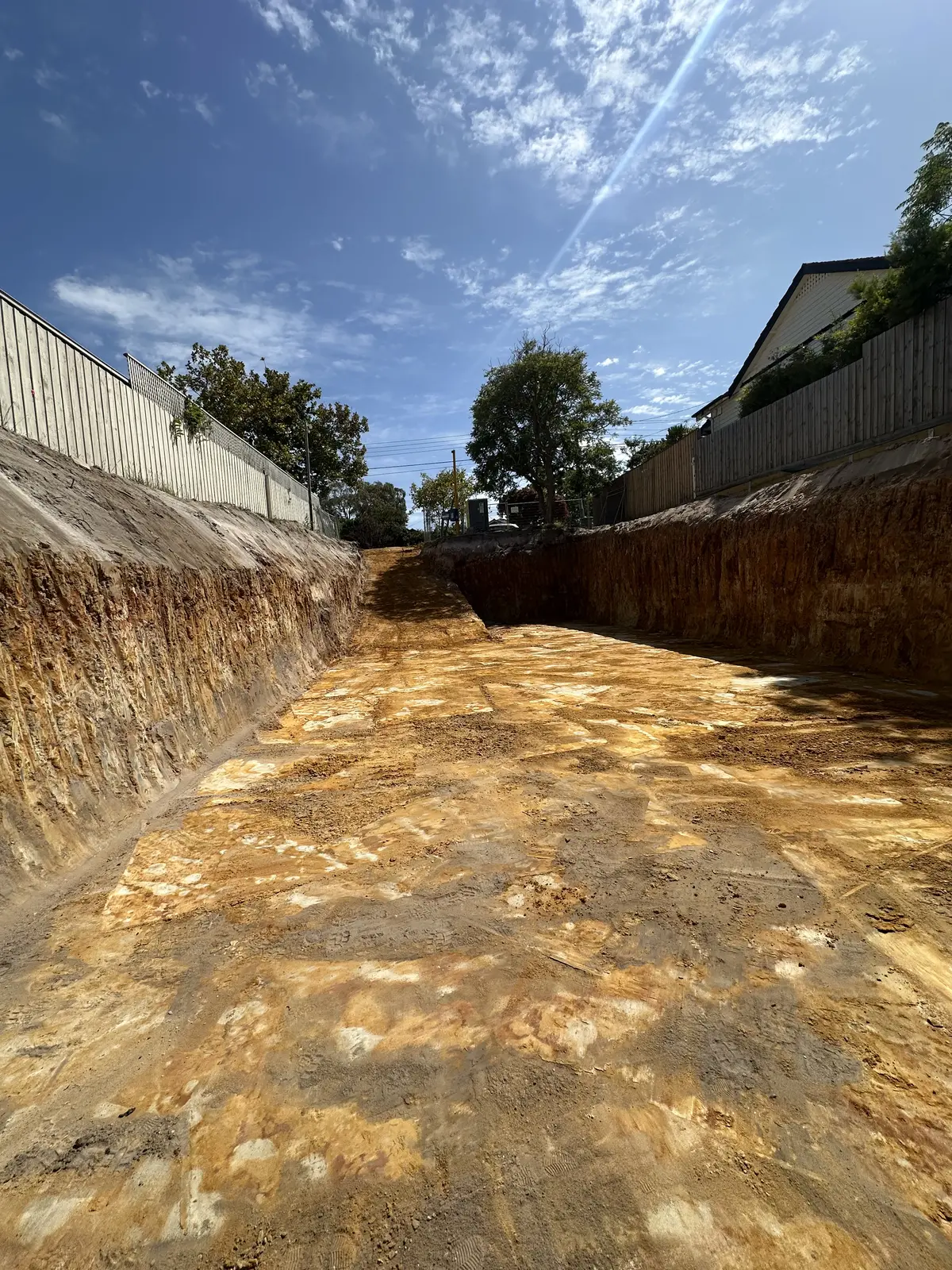
A site cut carves a level building platform out of a slope so your slab has somewhere flat to sit. Bulk excavation just means shifting a large volume of material, and it does not have to finish level at all. On a sloped block we are usually doing a cut and fill, taking the high side down and building the low side up, which keeps material on your property instead of in a truck. Worth being straight about that fill though. Soil we dig out is not automatically good structural fill. If it is going under anything that has to carry load it gets placed in layers, compacted and tested, and your engineer decides what passes. We cut to the levels shown on your plans, which normally come off your surveyor's set out. A basement is the dearer version of all this, and not because the dirt is any different. It is depth, restricted movement, double handling, retention, and every cubic metre having to leave.
What do you need ready before we bring a machine onto your block?
The set out, a datum we can work off, and the excavation levels marked on the plans. A finished floor level on its own is not enough, because the level we cut to and the level your floor ends up at are not the same number. After that it is clear access from the street and somewhere to put spoil if it is staying on site. On services, we lodge a Before You Dig Australia enquiry on every job, and we treat those plans as indicative rather than gospel, because that is what they are. Anything that matters gets located properly before a bucket goes near it. If the job involves a trench deeper than 1.5 metres, a shaft deeper than 2 metres or a tunnel, WorkSafe has to be notified three days beforehand, unless the work already sits under a building permit in force. We handle that end of it, you do not need to.
How do the ground and rock conditions around the Yarra Valley change a site cut?
They are the difference between a two day dig and a two week one. Around Wandin, Silvan and Monbulk you are mostly into deep red basalt soils. They dig well, but after a long wet spell they go greasy and anything driving on them churns it up. Conditions change quickly on these hills too, and mudstone or siltstone can turn up underneath with nothing on the surface to warn you. Some of it comes out with a bucket. Some of it needs the hammer, and that is usually where a price moves. The other thing we pay attention to around here is ground that has moved before. This pocket has a known history of slow slipping ground, so we look hard at existing slips, cracked ground, where the water goes, and how a cut face is going to be held. Where a face needs battering, benching or retention, that gets designed properly rather than eyeballed. It is the first thing we look at when we walk a job.
Where does the spoil go, and why do we ask what the block was used for?
The cheapest cubic metre of soil is the one that never leaves your block. On our Silvan job we moved 650 cubic metres and all of it stayed on the property, shifted across ready to level another area. That is always the first thing we look at. When soil does have to go, Victoria treats excavated soil as waste, and what it costs you comes down to which class it falls into. Soil that qualifies as EPA fill material is the cheap end. From 1 July 2026 the state waste levy on its own is $177.19 a tonne at a metropolitan landfill and $155.95 rural, and the tip's own gate fee sits on top of that. Soil that comes back as Category B is $296.18 a tonne. That is why we ask what your block was used for before we price cart away. Previous use tells us whether testing or a dearer disposal class is likely to come into it, and finding that out halfway through the dig is the expensive version.
How much room do we actually need to get a machine in?
More than most people think and less than most people fear. At the small end, machines in the 1.7 tonne class can pull their tracks in to under a metre, which gets through a lot of side gates once the gate comes off its hinges. A five tonne sits around 1.9 to 2 metres across, and five tonne is where a site cut starts moving at a sensible rate rather than nibbling at it. The gate is rarely the thing that stops us anyway. It is eaves, a meter box, an old retaining wall, a fence line that cannot come out, or a slope the machine has to get down and back up again. Send us a photo down the side of the house with something in shot for scale and we can usually tell you whether the five tonner has a chance or whether it is a mini job. Anything marginal we come and look at, because a photo will not tell you what the ground underneath is going to hold.
What actually holds a site cut up once it has started?
Rain, rock and trucks. Wet ground does not stop you digging, it stops you doing it neatly. Material sticks to everything, you cannot trim to a decent finish, and compaction goes out the window, so you lose the days after the rain as well as the day it fell. For what it is worth, the winter just gone was not the dry one that was forecast. Coldstream finished on 215.8mm, which is 108% of its long term average, and there were nights at minus 3.1 degrees in July. What that means for your block specifically still depends on your soil, your slope and your drainage, so it is a site by site thing rather than a number off a weather station. Rock is the second one, and you do not always know it is there until the bucket is in it. Trucks are the quiet one. Once spoil starts leaving site, the job runs at the speed of the truck cycle and not the speed of the machine, which is why keeping material on the block shortens jobs as well as saving money.