Rock walls across the Yarra Valley and Yarra Ranges. We cut the bank, bring the rock and build the wall in the one job. Six rock types in stock, real walls in Silvan and Kalorama to look at. Send a length and a height for a price, or call 0423 495 726.
A rock wall only keeps holding if the ground under it and the water behind it get sorted before the first rock lands. This is the order we want it done in on a Yarra Valley block, whatever the rock.
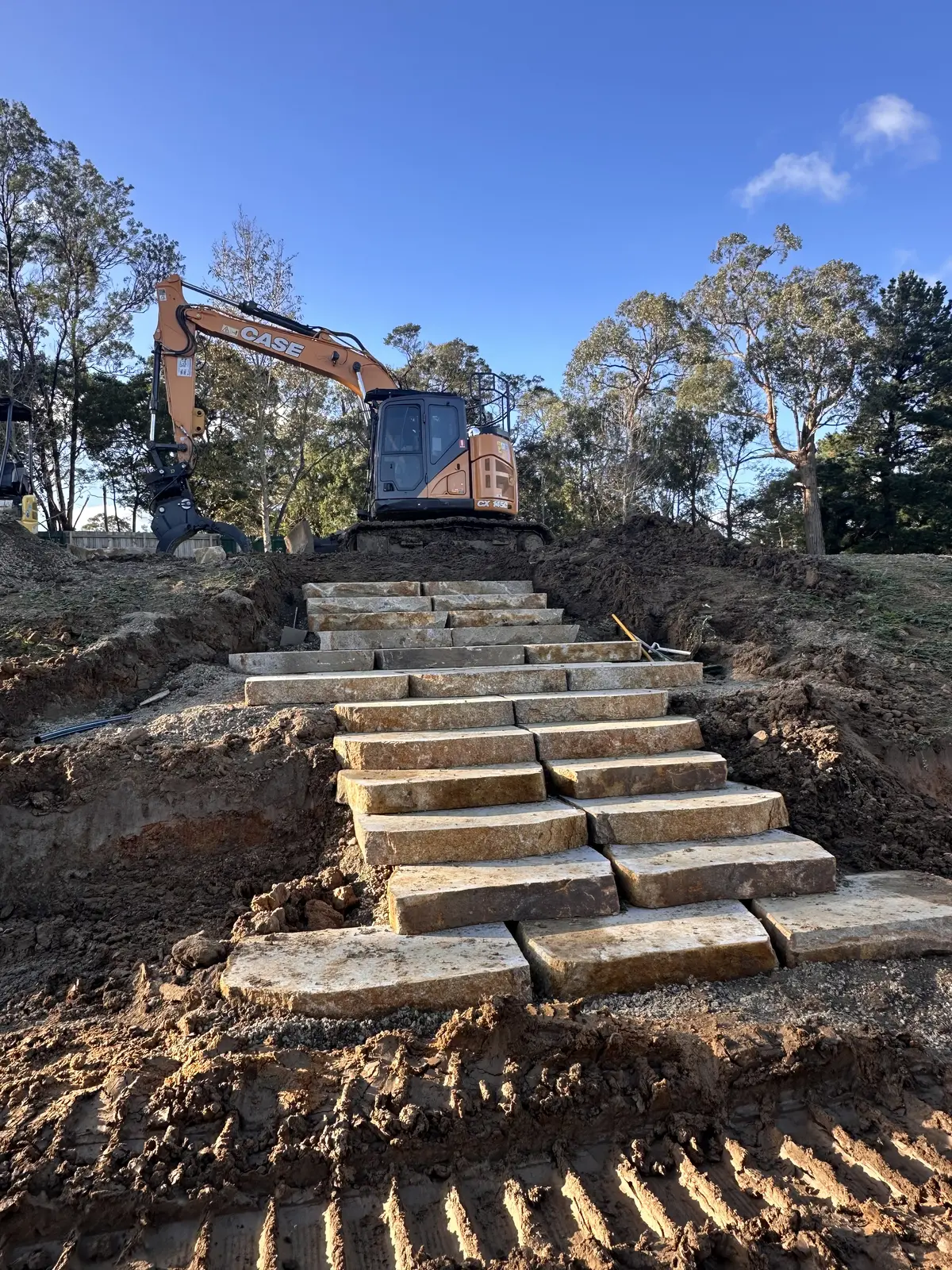
The cut. We take the bank back far enough to fit the rock and the drainage, with anything from a 2 to a 15 tonne excavator depending on how tight the block is. If the soil can stay on your block we keep it there, the way we did at Silvan, because soil that stays doesn't need a truck.
The base. The biggest, flattest rocks go in first, on firm ground or a compacted crushed rock base, usually 100 to 200 millimetres thick for a landscape wall. That bottom course carries everything above it. On an engineered wall the engineer sets the footing and we build to it.
The drainage. Free draining gravel behind the rock, an ag line along the bottom running somewhere the water can actually leave, and geofabric so the soil can't silt it up. The clay that came out of the hole doesn't go back behind the wall.
The rock. Every rock gets seated by machine so it bridges the joint below, and smaller stone packs the gaps. The face leans back into the bank, about 5 to 10 degrees on a dry stacked wall, so the weight pushes down and in instead of out.
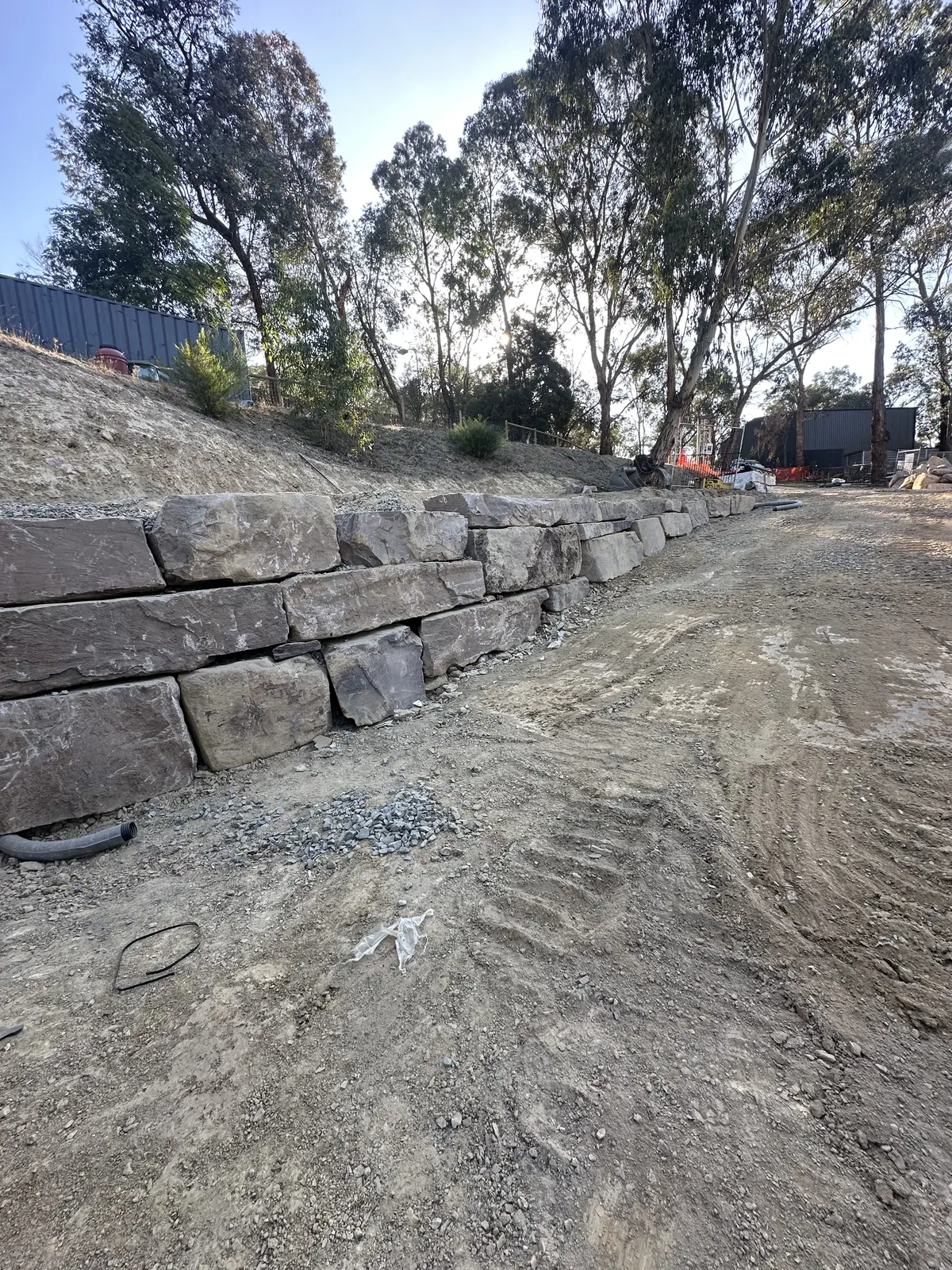
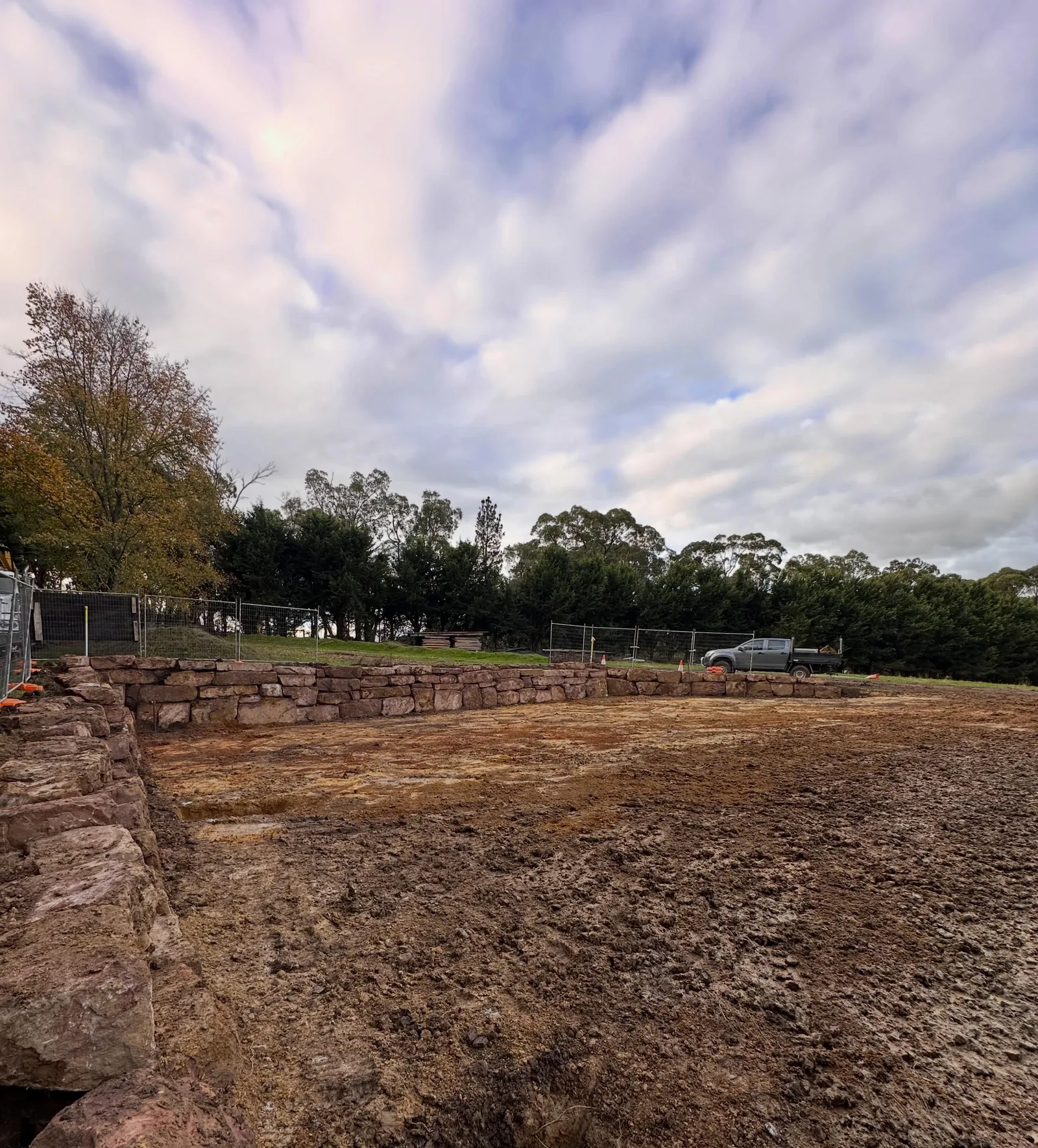
We cut 650 cubic metres out of a sloped block in Silvan and built a 50 cubic metre mudstone wall to hold the new level, five days start to finish. Not one truckload of soil left the property, and the pad went in ready for a big shed.
Fifty cubic metres runs to somewhere between 150 and 400 rocks, and each one gets picked up and placed on its own. Here's the whole Silvan job.
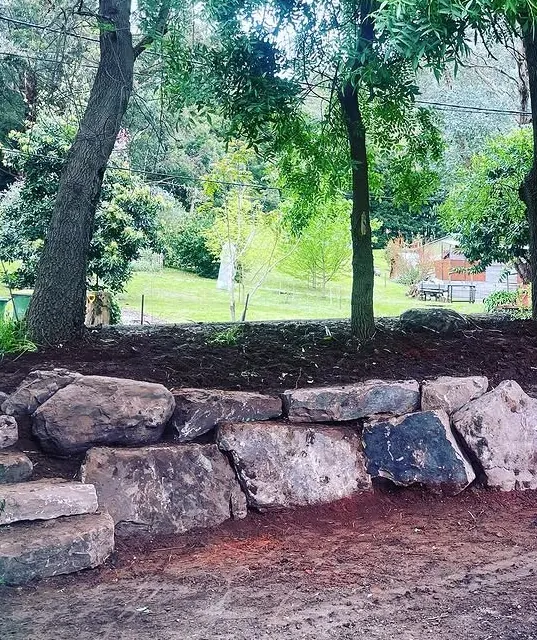
A smaller wall with different worries. Two courses of big mudstone, dry stacked with no mortar, holding a freshly mulched garden bed up above a dirt track, with a row of established trees still standing along the top. We posted it as finished in December 2022.
Up on the mountain, roots and rain matter more than volume. See our Kalorama mud rock wall for how we build around them.
In Victoria, a retaining wall one metre or higher needs a building permit. A lower wall can need one too, if it's tied to other building work or sits close enough to a boundary to put the place next door at risk. It's the retained height that counts, meaning the difference in ground level either side, not the rock you can see.
On a hill block the planning side can come first. Yarra Ranges Council names Silvan, the Dandenong Ranges, the Don River Valley and Warburton as prone to landslip, and land under the Erosion Management Overlay can need a planning permit and a geotechnical report before any wall goes in.
One metre of retained height is the line. Ask a building surveyor early, and expect an engineer's design with the application on anything over it.
Look your block up free on VicPlan before you book anyone. It takes a minute and it can change the whole job.
Lodge a free Before You Dig Australia enquiry at byda.com.au before any machine work starts.
Often not all the way, and that's fine. Our rock supply trucks carry 10 or 13 cubic metres and run about 2.55 metres wide, so the gate is rarely what stops us. On a hill block it's the steep or soft drive, or a track with nowhere to turn.
When the truck can't get close, the rock gets dropped at the nearest firm spot and we move it in by machine. It takes longer, so it goes in the price, and we'd rather know now than with a loaded truck in your street. A photo of the way in tells us most of it.
No two banks are the same, so we quote from a length, a height and a look at the site, not a rate off a list. There's a guide to what loose rock costs on our Silvan write up. These three move your number most.
Past a metre you add a permit and engineering, and bigger rock to carry the load.
Which rock you pick, how much of it, and how many truck movements that means.
How close a truck gets, where the machine can sit, and where the cut soil can go.
What we get asked before anyone books a rock wall, from Silvan and Monbulk through to Coldstream and Warburton.
Plan on one metre as the line. At a metre or more you need a building permit in Victoria, and councils generally want a structural engineer's design with that application. The Australian retaining wall standard, AS 4678, starts at 800 millimetres, so on a steep or loaded bank we may want an engineer's eye on a lower wall too. Tall dry stacked walls get designed, not eyeballed.
On a hill block we'd lean rock, because weight does the holding and there's no timber or steel post to wear out. It does take more room. A sleeper wall is thin and a rock wall isn't, so on a narrow strip beside a boundary sleepers can be the only thing that fits. We build in rock, so tell us if you're comparing and we'll say straight if your block suits it.
More than people picture. Rock for a wall around a metre high commonly runs up to 800 millimetres through, then the gravel and ag line go behind that, and the machine needs somewhere to stand while it works. A wall also leans back into the bank, so the bank has to be cut further than the face you end up seeing. Mark the line you're hoping for and send us a photo.
Do the rough sum: length by height by how thick the rock is. A wall 20 metres long, 900 millimetres high and 800 millimetres through comes to about 14 cubic metres, so roughly two tandem loads or one twin steer plus a bit. That's a sum and not a quote, because rock is sold loose and the real figure depends on the rock we use. Give us your length and height and we'll work it out properly.
Sometimes, but check first. A wall close to a boundary can need a building permit at any height if it puts the neighbour's property at risk, so a low wall doesn't automatically get a free pass. Protection work for the property next door can come into it too. Ask a building surveyor before you set it out, and tell us where the boundary runs when we walk the block.
It helps, but it's no promise. The Bureau of Meteorology's outlook issued 29 October 2026 says a strong El Niño is underway and still strengthening, with below average rain likely over small parts of southern Victoria. Dry ground is easier on trucks and machines than a soaked paddock. A strong El Niño doesn't guarantee a dry run on your hill, so we still judge the ground on the day.
Send through the suburb, roughly how long and how high the wall needs to be, and a photo of the bank and the way in if you can. Chris will come back to you.
Got a bank that needs holding up, anywhere through the Yarra Valley? Call Chris today.