Home About Services Projects Areas FAQ Contact Call Chris on 0423 495 726
Call Chris

KALORAMA MUDSTONE RETAINING WALL

A mudstone retaining wall we built under a row of established trees in Kalorama, up on the slopes of Mount Dandenong. Big rock, dry stacked, holding a garden bed up above a dirt track. Posted as finished in December 2022.

// The Job

MUD ROCK, UNDER THE TREES

This is a mud rock retaining wall we built in Kalorama late in 2022. Two courses of big mudstone, dry stacked with no mortar, holding up a freshly mulched garden bed along the edge of a dirt track, with a row of established trees still standing right along the top of it.

Mud rock is what we call mudstone on site. It's the warm brown and grey stone in the photo, and it turns up on more walls around the Yarra Ranges than anything else we stock. A wall like this does two jobs at once. It holds the bed up so the soil isn't slumping onto the track every time it rains, and it gives the trees a solid edge instead of a bank that crumbles a bit more each winter.

Suburb
Kalorama
Posted Finished
18 December 2022
Rock
Mudstone (mud rock)
Build
Dry stacked, two courses
  • Large mudstone rocks dry stacked in two courses, no mortar
  • Garden bed behind the wall finished with fresh mulch
  • A row of established trees still standing along the top of the wall
  • The track below left clear of soil

Posted from the job, 18 December 2022: “Mud rock retaining wall we recently completed in Kalorama.” See the original on our Instagram
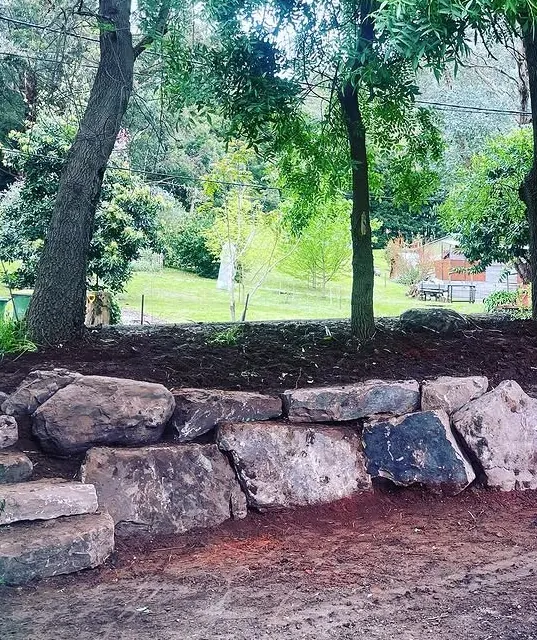
Two courses of large mudstone rocks dry stacked as a retaining wall in Kalorama, holding a freshly mulched garden bed under a row of established trees
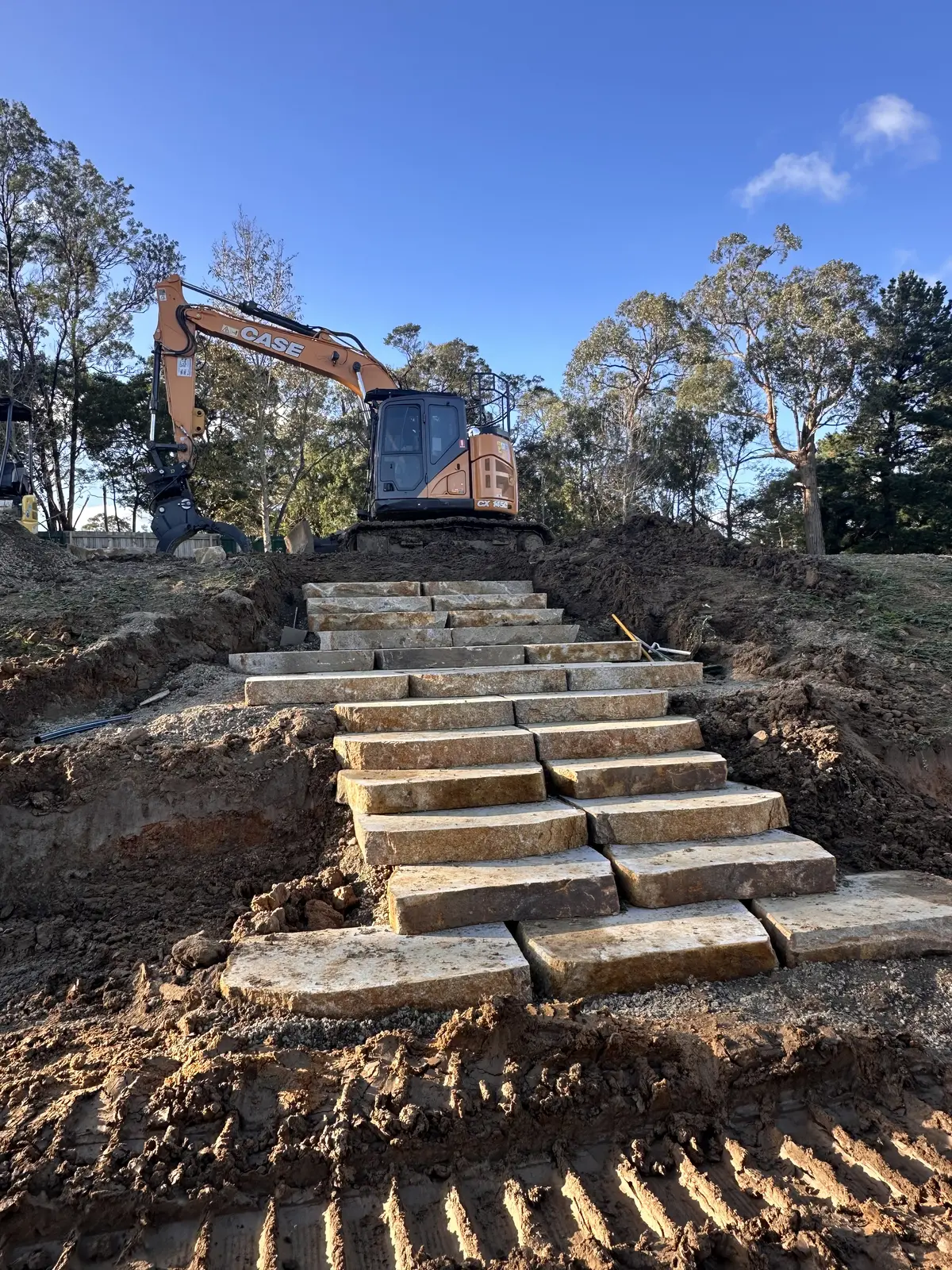
Entire Excavations excavator with rock staged ready for a wall build
// The Ground

A VOLCANIC HILL, A MUDSTONE WALL

Kalorama sits on the slopes of Mount Dandenong, and the range under it is mostly old volcanic rock, Devonian dacite and rhyodacite from a volcano last active around 373 million years ago. Much of the country around the range sits on Silurian mudstone and siltstone instead, the same rock we built with on our Silvan site cut and rock wall.

So on the mountain, mudstone for a wall comes in on a truck rather than out of your own cut. We keep it in stock with the rest of our rock supply range, so we can bring the rock and build the wall in the one job. More on our rock wall builds.

The bigger difference up here is water. The old Bureau of Meteorology station on Mount Dandenong averaged 1,203 millimetres of rain a year across its record, falling on about 136 days. May was the wettest month, then August, then November. That's a lot of water moving through the soil behind a wall, and on a hill job the drainage gets as much of our attention as the rock does.

Behind a wall like this we want the water to have a way out: free draining gravel against the back of the rock, and a slotted ag pipe along the base run out to somewhere it can discharge. Without that, the bed behind fills like a sponge, the soil gets heavy, and over a few winters the face starts to lean.

// The Trees

BUILDING AROUND TREES

The trees along the top of this wall were there long before the rock. Mature trees on a hill block are worth keeping, and they're often holding a bank together better than anything we could put in. The catch is that their roots run a long way past the trunk.

AS 4970, the Australian Standard for protecting trees on development sites, sets a tree protection zone with a radius of twelve times the trunk diameter, measured 1.4 metres up the trunk. A tree with a trunk 400 millimetres across gets a protection zone of 4.8 metres in every direction. On a narrow strip between a track and a row of trees, a wall almost always ends up inside that line.

That doesn't rule a wall out, but it changes how we build it. We keep the cut behind the rock as shallow as the wall allows, keep the machine and any stockpiles off the root zone, and if we hit a big root we stop and talk to you before anything gets cut. If a tree really matters to you, get an arborist to look at it before we set the wall out.

// Before You Start

WHAT A KALORAMA BLOCK NEEDS CHECKED

If you're thinking about a rock wall on a block in Kalorama, Olinda or anywhere else up on the mountain, these are the things we'd want sorted before we quote.

The Erosion Management Overlay schedule in the Yarra Ranges planning scheme names the mountains of the Dandenong Ranges among the land prone to landslip. If your block is in it, a retaining wall only skips a planning permit when it's under a metre high, the ground ends up within a metre of natural level, it isn't part of a building, and it isn't protecting the land next door from slipping. Miss any one of those and you need a permit before we start.

Separately, a wall over a metre high always needs a building permit, overlay or not. You can check your block for free on VicPlan, the state government planning map, and lodge a free Before You Dig Australia enquiry before any machine work so you know where the services run.

Erosion Management Overlay

Look your block up on VicPlan first. The schedule covers the mountains of the Dandenong Ranges, and only small walls that leave the ground close to natural level are exempt.

The Wet Months

May and August are the wettest months on the Mount Dandenong record. Book the dig for when the ground will carry a machine without tearing up.

Tree Roots

Twelve times the trunk diameter is the protection radius. Know where that line falls before the wall gets set out.

// FAQ

MUD ROCK WALL QUESTIONS

What people ask us about rock walls up in the hills, from Kalorama and Olinda across to Silvan and Monbulk.

Is mud rock the same as mudstone?

Yes. Mud rock is just what we call it on site. Mudstone is a sedimentary rock made from fine mud and clay pressed into stone, and it breaks into blocky pieces in warm browns and greys. It's the rock in the photo on this page, and it's one of the types we keep in our own yard.

Why build a mudstone wall in Kalorama when the mountain is volcanic rock?

Because the rock under a hill block isn't always the rock you want in a wall. The Dandenong Ranges are mostly Devonian dacite and rhyodacite, while much of the country around them sits on Silurian mudstone and siltstone. Mudstone comes in by the truckload, stacks tight without mortar, and its colours sit easily against mulch and bush. Pick the rock for how it builds and how it looks, not for what happens to be under your block.

Does a rock wall in the hills need drainage behind it?

Yes, every time. The old Bureau of Meteorology station on Mount Dandenong averaged about 1,203 millimetres of rain a year, on roughly 136 days. Water that can't get out from behind a wall makes the soil heavy and pushes on the rock. We want free draining gravel behind the wall and a slotted pipe along the base, run out to somewhere the water can actually go.

Can you build a retaining wall close to big trees?

Usually, with care. AS 4970, the Australian Standard for protecting trees on building sites, sets a protection zone with a radius of twelve times the trunk diameter, measured 1.4 metres off the ground. A trunk 400 millimetres across means 4.8 metres. Inside that line we keep the cut shallow, keep the machine and stockpiles off the roots, and stop to talk to you before anything big gets cut. For a tree that matters to you, get an arborist in first.

Do I need a permit for a rock wall in Kalorama?

Possibly two. If your block is under the Erosion Management Overlay, which in the Yarra Ranges covers the mountains of the Dandenong Ranges, a wall only skips a planning permit when it's under a metre high, the ground stays within a metre of natural level, it isn't part of a building and it isn't protecting the land next door. Separately, a wall over a metre high always needs a building permit. Check your block on VicPlan before you book anyone.

When is the best time of year to build a rock wall up on the mountain?

When the ground will carry a loaded machine without churning. Kalorama doesn't really have a dry season. On the Mount Dandenong record May is the wettest month, then August, then November. Late spring through to autumn is usually kinder, but we judge it on the ground on the day rather than on the calendar. We posted this wall as finished in December.

// Get a Price

TELL US ABOUT YOUR WALL

Send through the suburb, roughly how long and how high the wall needs to be, and a photo of the bank if you can. Tell us about any big trees close by and how a truck gets in. Chris will come back to you.

// Let's Talk Earthmoving

READY TO
DIG IN?

Got a bank that needs holding up in Kalorama or anywhere through the hills? Call Chris today.

Call Chris on 0423 495 726 Send an Enquiry
Free quote