Home About Services Projects Areas FAQ Contact Call Chris on 0423 495 726
Call Chris

SILVAN SITE CUT & MUDSTONE ROCK WALL

650 cubic metres cut, a 50 cubic metre mudstone retaining wall, five days on site. Not one truckload of soil left the property.

// The Job

FIVE DAYS, NOTHING CARTED OFF

We cut 650 cubic metres out of a sloped block in Silvan and built a 50 cubic metre mudstone rock retaining wall to hold the new level. Five days, start to finish.

The soil never left the property. We moved it across the block, ready to level a second area, and that one decision is why this was a five day job instead of a multi week one. The new pad was going under a big shed.

Volume Cut
650 cubic metres
Rock Wall
50 cubic metres of mudstone
Time On Site
5 days
Soil Carted Off
None
  • Cut 650 cubic metres out of the sloped section of the block
  • Built a 50 cubic metre mudstone rock retaining wall to hold the new level
  • Kept every cubic metre of soil on the property, ready to level a second area with it
  • Left the pad clean and ready for the shed build

Finished and posted from site, 20 May 2026. See the original on our Instagram

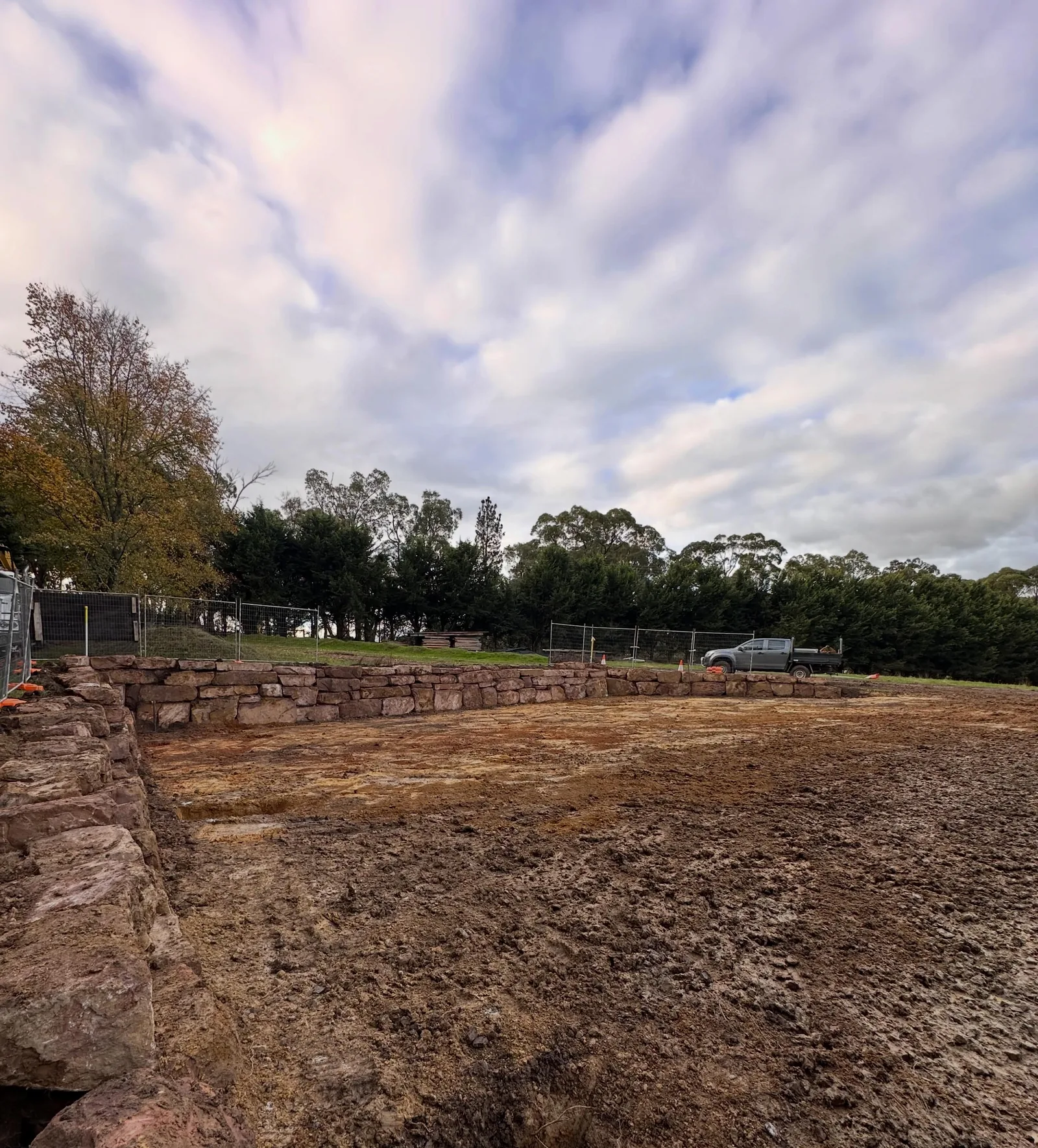
Completed 650 cubic metre site cut in Silvan with the finished mudstone rock retaining wall holding the new level
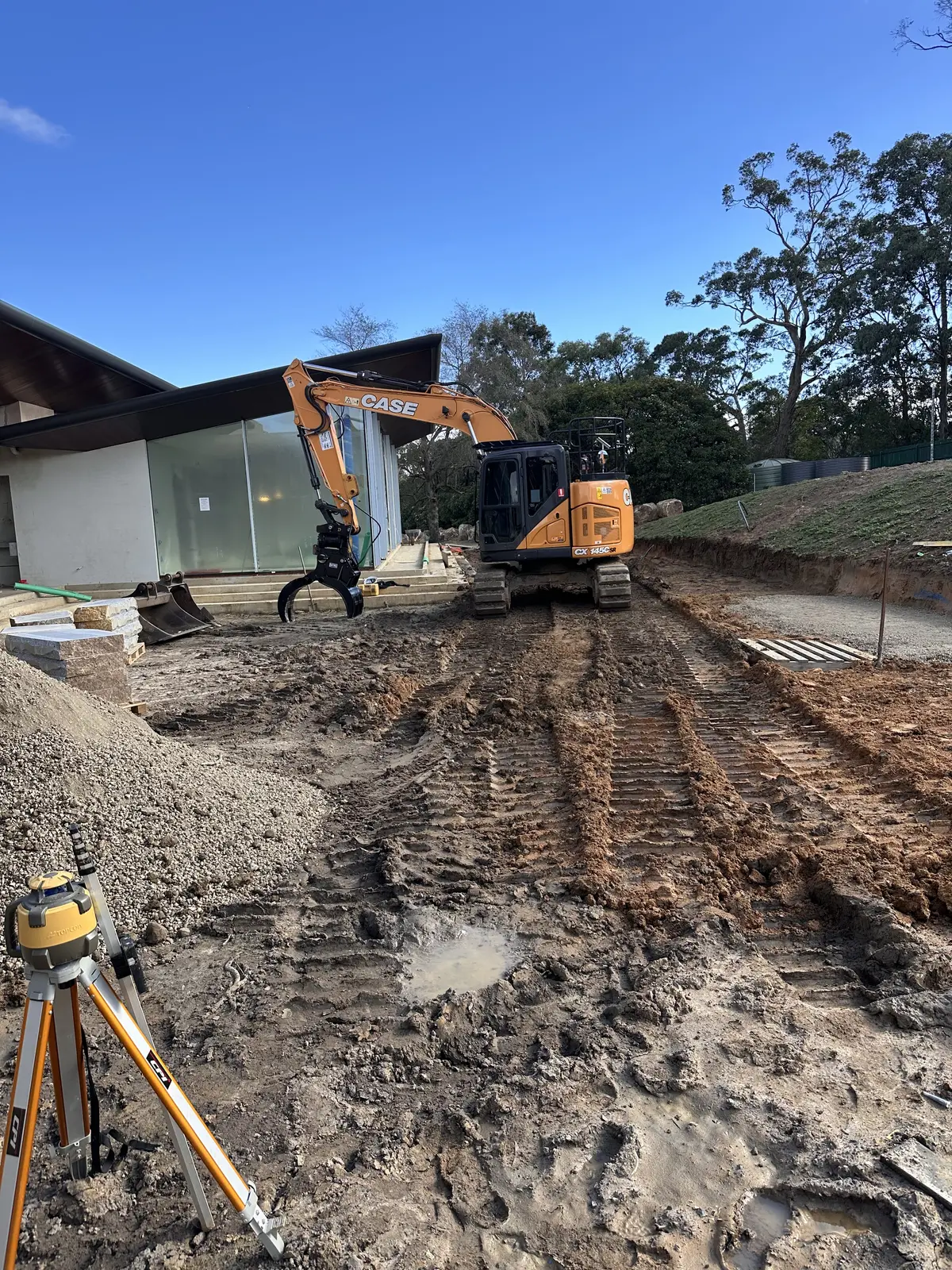
Entire Excavations excavator on a graded site with laser level set up
// Why It Mattered

THE SOIL IS THE BUDGET

On a cut this size the digging usually isn't your biggest cost. What happens to the dirt afterwards is.

Soil expands the moment it comes out of the ground. A cubic metre in the ground becomes roughly 1.15 to 1.3 cubic metres once it's loose in a truck, depending on how much clay is in it and how wet it is. So 650 cubic metres measured in the ground is closer to 750 or even 845 cubic metres of material to shift. In a 20 cubic metre truck that's more than 40 loads.

Soil disposal around Melbourne runs somewhere between $30 and $80 a cubic metre once cartage and tipping are both counted, and licensed receiving facilities charge by the tonne against the EPA classification of the soil rather than by volume. Run that over 750 cubic metres and you're into five figures before a slab has been poured.

Keeping it on the block took all of that off the bill. No trucks queuing on a rural road, no weighbridge dockets, no soil classification, and the material was already sitting where the next area needed it.

It won't work on every block. You need somewhere that actually wants filling, ground that will take it, and enough room for us to run a machine between the two. On a tight suburban site there's usually nowhere for it to go, which is what we ran into on a Healesville block with nowhere to put anything. On acreage through the Yarra Ranges there often is, and it's the first thing we look for when we walk a job.

// The Rock

WHY WE USED MUDSTONE

Mudstone is broadly what the Yarra Ranges is made of. The bedrock through this part of Victoria is a thick sequence of Silurian mudstone, siltstone and claystone, laid down as marine sediment and later folded into the hills you can see from the block. A mudstone wall doesn't look imported, because geologically it isn't.

It's also good to build with. It breaks into squarish, roughly rectangular pieces with softer edges, so it dry stacks tight without mortar and without us cutting anything on site.

Fifty cubic metres is a serious amount of rock. At three to eight rocks per cubic metre for stone in the 300 to 800 millimetre range, that's somewhere between 150 and 400 pieces, and every one of them gets picked up and placed individually.

  • Stone of 200 to 800mm suits walls between 600mm and 1.5 metres
  • Walls over 1.5 metres want 600mm stone and up for the mass
  • Rock is sold loose by the cubic metre, not by weight
  • As a guide, landscape rock around Melbourne runs about $135 to $320 a cubic metre depending on type, supply only, before installation

Mudstone is one of six rock types we keep in stock, alongside yellow granite, field granite, highland slate, basalt, Coldstream and Yarra Valley rock. We'll supply it loose to your site, or supply and install it the way we did here. Have a look at the full rock supply range.

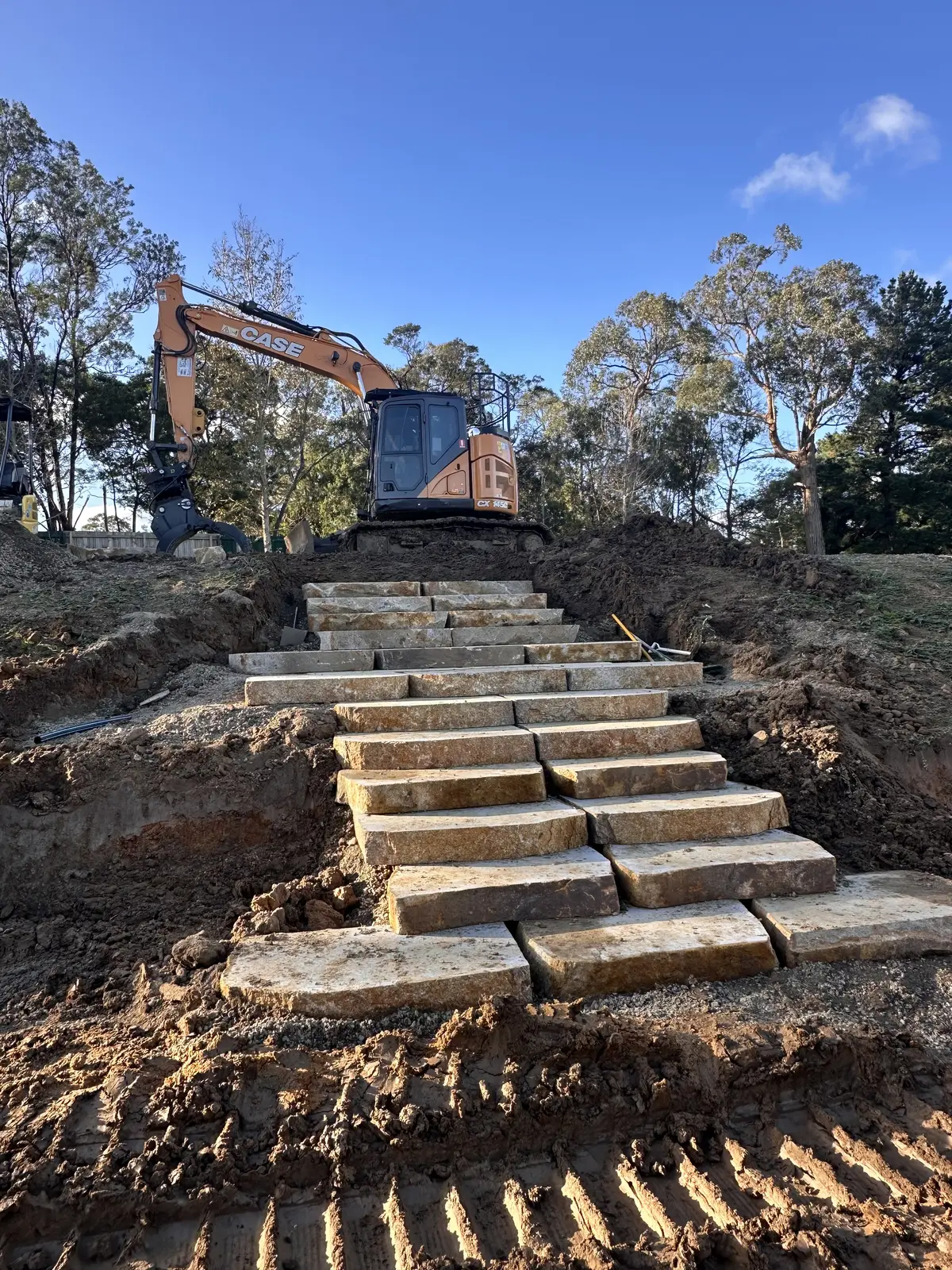
Entire Excavations excavator with rock staged ready for a wall build
// Before You Start

WHAT A SILVAN BLOCK TRIGGERS

If you're planning something similar, this is what we'd want checked before anyone quotes you machine time.

Yarra Ranges Council names Silvan as one of the areas of the shire prone to landslip, along with the Dandenong Ranges, the Don River Valley and Warburton. Land at risk sits under an Erosion Management Overlay, and that overlay changes what you're allowed to do with a slope.

If your block is covered, you'll very likely need a planning permit before any earthworks, and the application has to include a report from a qualified geotechnical engineer. Where natural slopes on or immediately next to the lot are steeper than 30 percent, or steeper than 20 percent in Tertiary Basalt areas, or there's evidence of past land sliding, a landslip risk assessment is required on top of the geotechnical assessment. If that comes back at moderate or higher risk of property loss and it can't be mitigated, Council can't approve the permit.

You can check your own block for free on VicPlan, the state government planning map. Worth knowing before you do: the mapping is being redrawn. Amendment C225 went on exhibition in 2025, drew 84 submissions, and Council referred those to an independent planning panel in December 2025. The proposed mapping would take the number of affected properties across the shire to 13,434. A block sitting outside the overlay today isn't guaranteed to stay outside it.

The wall is a separate question. Under the Building Regulations 2018 a retaining wall only escapes a building permit if it retains less than one metre, isn't associated with other building work, and isn't protecting an adjoining property. Retained height means the difference in ground level either side of the wall, not the height you can see once we're finished. That last exemption catches people out. A wall built as part of a shed or house job counts as associated with other building work, so the one metre rule stops applying.

None of this is meant to put you off. We'll walk the block with you and tell you straight what we think it needs. What we won't do is start moving dirt on a site that should have had a geotechnical report first.

Erosion Management Overlay

Check your block on VicPlan first. If it's covered, budget for a geotechnical report and a planning permit before anyone quotes machine time.

Building Permit On The Wall

One metre of retained height is the threshold, and it stops applying the moment the wall is tied to other building work. Ask your surveyor early.

Underground Services

Before You Dig Australia is free. Lodge at byda.com.au, through the app, or on 1100. Plans often land within minutes, but allow two business days.
// FAQ

SITE CUT & ROCK WALL QUESTIONS

The questions we get asked most on jobs like this one, across Silvan and the wider Yarra Ranges.

How long does a 650 cubic metre site cut take?

This one took us five days, including the 50 cubic metre rock wall. That pace depends heavily on the soil staying on site. Once material has to be loaded and carted, the job runs at the speed of the trucks rather than the speed of the machine, and the same volume can stretch across several weeks. Rock in the cut, wet ground and tight access all slow it down further.

How much does soil expand once it has been dug up?

Between about 15 and 30 percent, depending on the material. Clay bulks more than sand, and saturated clay bulks more again. So 650 cubic metres measured in the ground becomes roughly 750 to 845 cubic metres of loose material once it's out. It matters to you because cartage is priced on what actually leaves the site, not on what the plan says was cut.

What does it cost to cart excavated soil off a Melbourne site?

Broadly $30 to $80 a cubic metre once cartage and tipping are both counted, but the real driver is the EPA classification of the soil. Clean virgin excavated natural material is the cheapest to place at a licensed receiving facility. Anything with a contamination history costs considerably more and needs testing before removal is even booked. Access and haul distance move the number too. We'll get the classification sorted before we put a figure on it.

How do I find out if my Silvan block is in the Erosion Management Overlay?

Look it up free on VicPlan, the Victorian government planning map, which shows every zone and overlay on a property. If the overlay applies you'll need a planning permit for buildings and works, supported by a report from a qualified geotechnical engineer. Keep in mind the mapping is currently under review through Amendment C225, so it's worth rechecking rather than relying on an old search. We'll flag it if we think your block is affected, but the search takes a minute and costs nothing.

How much mudstone rock does a retaining wall need?

Rock is sold loose by the cubic metre, so the figure follows the size of the wall face and how deep the rock sits. We used 50 cubic metres on this one. For stone in the 300 to 800 millimetre range you get roughly three to eight rocks per cubic metre, which puts 50 cubic metres at somewhere between 150 and 400 pieces. Walls up to about 1.5 metres suit 200 to 800mm stone. Above that you want 600mm and larger for the mass.

Why is mudstone used for retaining walls around the Yarra Ranges?

Two reasons. It suits the setting, because the bedrock through this part of Victoria is Silurian mudstone, siltstone and claystone, so the rock reads as local rather than trucked in from somewhere else. And it builds well. Mudstone breaks into squarish pieces with softer edges, which dry stack tight without mortar and without needing to be cut on site.

// Let's Talk Earthmoving

READY TO
DIG IN?

Got a sloped block in Silvan or anywhere across the Yarra Valley? Call Chris and we’ll talk it through.

Call Chris on 0423 495 726 Send an Enquiry